
The Case for Sovereign Restructuring in Nigeria By
Charles Obinna Chukwunaru, PhD, President, Eastern Nigeria Development Association (ENDA)
The viability of Nigeria as a unified state is increasingly being questioned by scholars and policy stakeholders due to persistent systemic instability. In 2026, critical indicators—including escalating insecurity, targeted violence against religious and ethnic groups, and profound institutional corruption—suggest a governance crisis that the current political framework appears unable to resolve.
Historical Context and Legal Framework: The 1914 Amalgamation of the Northern and Southern Protectorates and the Lagos Crown Colony was an administrative decision by British colonial authorities to optimize economic resources. While popular discourse often references a “100-year expiration” on this union, historical and fact-check analyses by experts from sources like Dubawa and Vanguard clarify that there is no formal treaty or expiration clause within the original colonial edicts. However, the 112-year anniversary of this union in 2026 serves as a significant milestone for evaluating its modern legitimacy and the consent of the governed.
Institutional Fragility and Historical Grievances: Since the 1966 pogroms and the subsequent civil war (1967–1970), the Nigerian state has struggled to manage its ethnic and religious pluralism effectively. The failure of the post-1999 political class to facilitate a return to the 1963 Parliamentary Constitution viewed by many as the only authentic document to address “unity in diversity” has led to a collapse in public trust and an increase in regional self-determination movements.
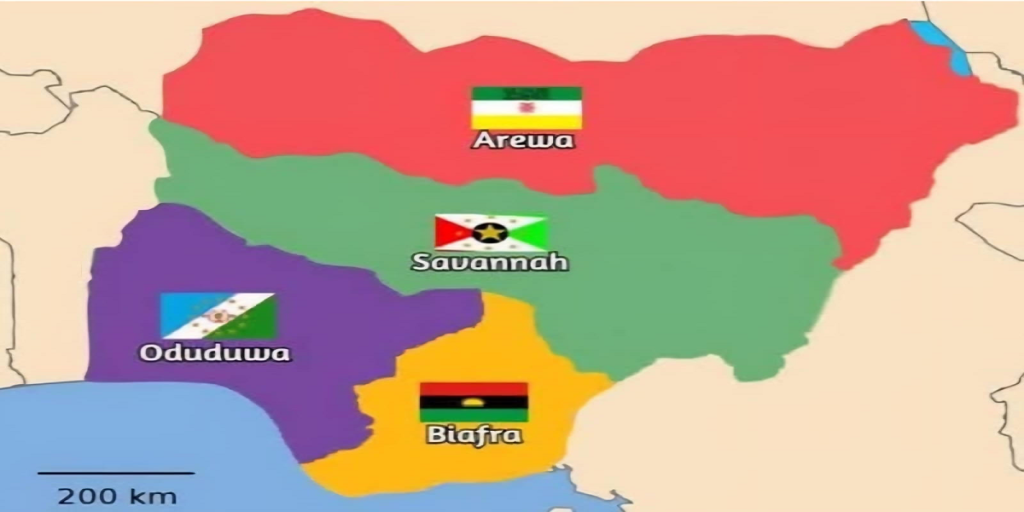
Proposed Path to Stability: Strategic Sovereign Division: To mitigate further humanitarian crises and protect the lives of citizens within these volatile regions, a structured transition is proposed. A peaceful, internationally supervised referendum should be considered to allow for the formation of distinct, sovereign nations, potentially including:
Arewa (Northern region)
Oduduwa (South-western region)
Biafra (South-eastern region)
Savanna (Middle Belt/Central region).
This approach aligns with international principles of self-determination and offers a strategic alternative to the cycle of low-intensity violent conflict that continues to hinder development in West Africa.