

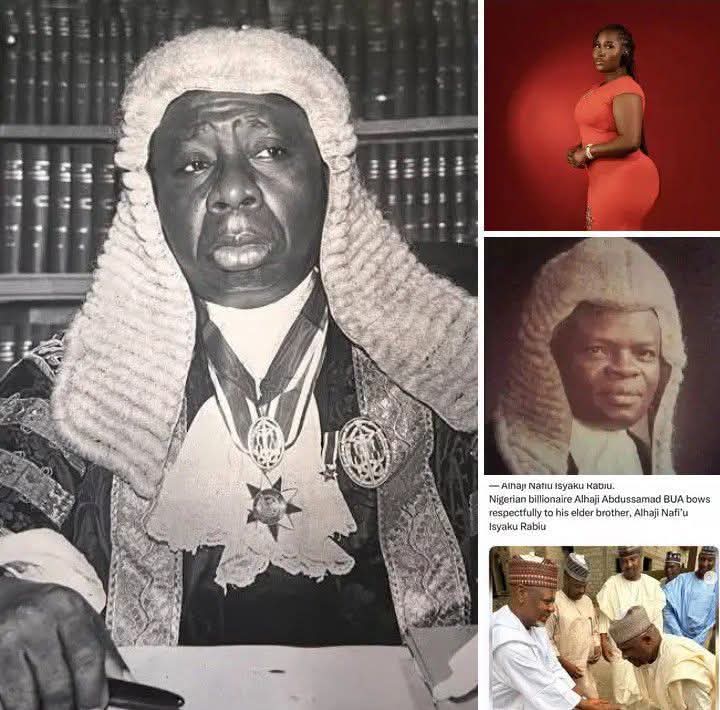
This Habila’s case just reminded me of one of the most controversial criminal cases, as well as one of the most controversial judicial decisions, that has ever gone before our courts.
Let me tell you a very sad story.
On May 9, 1979, there was a quarrel between Nafiu, a wealthy and high-profile businessman who is the eldest son of the influential Islamic scholar and business tycoon, Alhaji Isyaku Rabiu, and his wife, Hajiya Fati Mohammadu Nafiu, in their home in Kano.
The following morning, Nafiu began to behave in a highly strange and inconsistent manner.
He claimed to have lost his house keys and asked his cook to open the kitchen door. Not long after, he was seen putting soiled blankets and clothes into the boot of his Peugeot 504.
He then handed the keys to his cook and instructed him to serve his wife whenever she woke up, insisting that she was still asleep. According to those around him, Nafiu had never behaved that way before that day.
Hours later, his children and the cook became worried after waiting endlessly for their mother to come out of the room. They eventually went upstairs to wake her up.
What they found shocked everyone.
Hajiya Fati Mohammadu Nafiu was de@d.
The circumstances surrounding her de@th pointed in one direction. Someone had taken her life at night.
The Police suspected that she died from strangulation and immediately ordered an autopsy.
A team of medical experts and pathologists examined the body and concluded that the cause of de@th was asphyxia resulting from strangulation.
They also found visible marks of violence on her body.
Nafiu, however, maintained that his wife died peacefully in her sleep.
The Police did not believe his explanation.
So he was subsequently charged to court.
At the High Court of Kano State, the trial judge, Chief Justice Jones, after examining the evidence, held that the medical evidence was conflicting and unsatisfactory.
According to him, the prosecution failed to prove beyond a reasonable doubt that the deceased died from strangulation. On that basis, he acquitted and discharged Nafiu Rabiu.
Because Nafiu Rabiu’s family was one of the most powerful families in Kano, the judgment generated widespread public outrage.
To satisfy the yearnings of the people, the Kano State Government appealed the decision to the Federal Court of Appeal.
The Court of Appeal found that the trial judge failed to properly evaluate the evidence before him. Consequently, it overturned the acquittal and convicted Nafiu Rabiu.
But here came the interesting twist.
Instead of sentencing Nafiu Rabiu to de@th for culpable homicide, the Federal Court of Appeal held that he did not take his wife’s life in cold blood. The court reasoned that the death must have resulted from a fight.
Relying on Section 222(4) of the Penal Code, the court convicted him of the lesser offence of culpable homicide not punishable with de@th and sentenced him to just four years imprisonment.
Nafiu Rabiu appealed to the Supreme Court.
The Supreme Court, in a judgment delivered by Justice Sir Udo Udoma, dismissed his appeal and affirmed the four-year prison sentence.
Interestingly, the Supreme Court openly expressed its frustration.
The court made it clear that it could not do what it considered proper justice by sentencing Nafiu Rabiu to de@th because the Kano State Government, at the peak of the proceedings, had withdrawn its cross-appeal which sought the de@th sentence.
That single decision tied the hands of the Supreme Court.
In the end, Nafiu Rabiu spent only four years in prison for an offence that ended the life of his wife under very mysterious circumstances.
That same Nafiu Rabiu is the elder brother of Abdul Samad Rabiu who is the Founder and Chairman of the BUA Group today.
The man who defended Nafiu Rabiu was Chief F.R.A. Williams, SAN, while Kehinde Sofola, SAN represented the Kano State Government.
This story is a painful reminder that it has been a long time coming for the wealthy to keep getting away with offences that could completely destroy the l!ves of ordinary people.
Till today, that case remains one of the most controversial constitutional and criminal law decisions in Nigeria’s legal history. It is still frequently cited by lawyers as Nafiu Rabiu v. The State (1980) 8–11 S.C. 130.
I am Ekene Aninze Esq.
Abuja Network News