
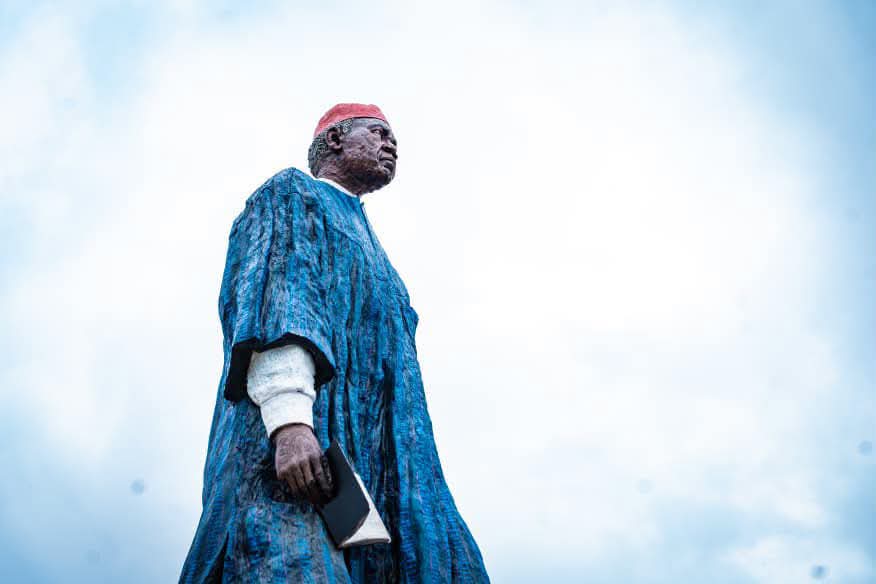
A few hours ago, the Governor of Anambra State unveiled a statue at Ugwunwasike, Ogidi, to celebrate and immortalize one of the world’s greatest literary icons, the late Prof. Chinua Achebe.
Since the unveiling, I have seen a cross-section of opposition figures and social media critics attacking the statue, arguing that it does not bear a close resemblance to the legendary author. However, I believe such arguments are largely driven either by a misunderstanding of artistic expression or by a deliberate attempt to mislead the public.
Art is not always about reproducing a perfect physical likeness; it is often about capturing the essence of a person. As Pablo Picasso famously said, “Art is the lie that enables us to realize the truth.” A sculptor whose goal is to evoke emotion may deliberately alter certain physical features to portray a subject’s courage, intellect, resilience, or inner strength rather than merely replicate facial details. Such stylistic choices are common in artistic movements like modernism and cubism, where symbolism often takes precedence over photographic realism.

Likewise, sculptors sometimes intentionally distort proportions so that a monument achieves the desired visual effect when viewed from a distance. This artistic principle has been applied in several famous monuments around the world, including the Martin Luther King Jr. Memorial in the United States, artistic depictions of Queen Amina of Zaria on horseback, and the African Renaissance Monument in Senegal. None of these works is judged solely by photographic accuracy; they are celebrated for the stories, values, and ideals they embody.
Unfortunately, while some armchair critics are preoccupied with measuring noses, cheeks, and jawlines, they are missing the bigger picture. As the saying goes, “When a wise man points at the moon, only a fool looks at the finger.” The true significance of the monument lies not in whether every facial feature perfectly matches Prof. Achebe’s photographs, but in the fact that Anambra State has chosen to honour one of Africa’s greatest intellectuals for generations yet unborn. A people who celebrate their heroes inspire future heroes.
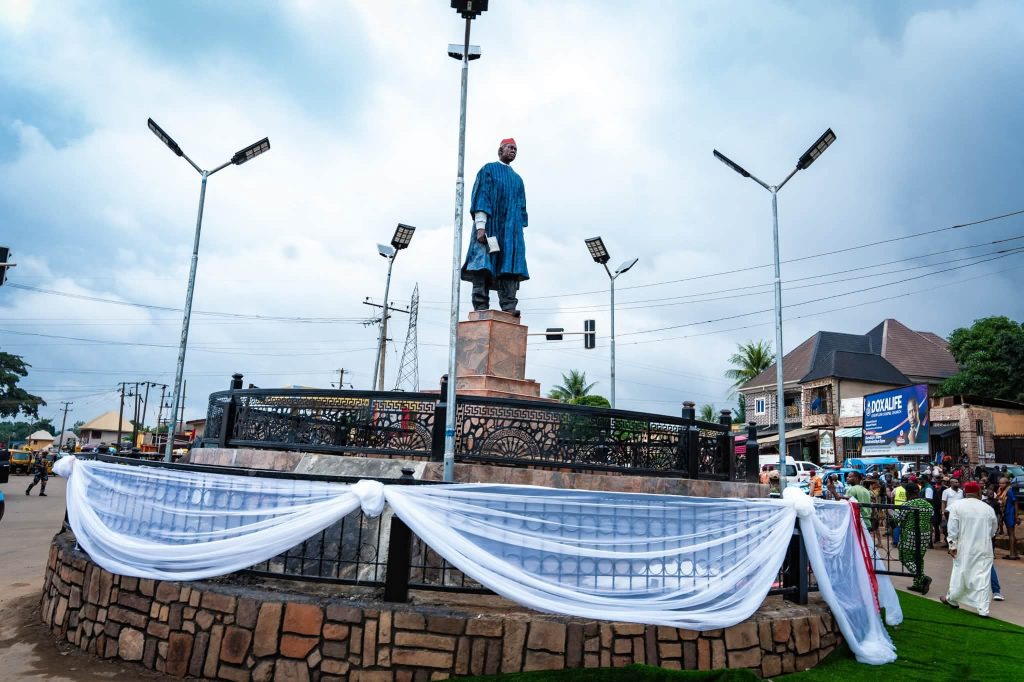
Whether critics like it or not, the moment that statue was unveiled, it became a permanent symbol of Prof. Chinua Achebe’s extraordinary legacy. Anyone who beholds it immediately remembers the man who gave Africa a powerful literary voice and reshaped global perceptions of the continent through his timeless works. The monument serves as a classroom without walls, reminding young people that excellence, integrity, and intellectual courage deserve celebration.
After all, many people have taken photographs of themselves that they hardly recognize at first glance. Yet no one disputes their identity because a picture—or even a sculpture—is only a representation, not the person himself. The same principle applies here. The issue is not whether the statue is a perfect replica; the issue is that it stands as a lasting tribute to a man whose legacy will outlive generations.
As the African proverb wisely says, “A man dies twice: once when he is buried, and again when his name is forgotten.” By immortalizing Prof. Chinua Achebe in his hometown, Anambra State has ensured that his name, ideals, and contributions will continue to inspire countless generations. That, ultimately, is the true purpose
By Machi Pius Igwe